“Veronica Mars” (2014) nine years later
4 June 2014
I loved Veronica Mars, that So-Cal noir series that ran between 2004 and 2007. (Especially the first two seasons.) Her bitterness was so vividly explained. The class battles between the haves and have-nots always peppered the show, even as it cynically reminded us (as good noir does) that the wealthy and privileged have the means to insulate themselves against justice no matter how much Veronica tried to fix it. The series was also funny, with wonderful characters (Vinnie Van Lowe, the comic genius of Dick Casablancas). It ended too soon, and remains worthy of re-watching even now.
Veronica (Kristen Bell) was razor-sharp — that nose, that jawline, that cutting sense of humor — but the show was always fundamentally about her sadness, her loneliness. Perfect noir. Perfect for those of us for whom high school remains weirdly mythopoeic.

Considering that sharpness, you couldn’t be surprised by Bell’s post-Veronica career as Veronica’s opposite: a privileged mean girl (Heroes, Forgetting Sarah Marshall, Parks and Recreation, the narrator’s voice in Gossip Girl). Which made me realize that her capacity for bitchiness always underlay her success as Veronica, too — Veronica was the girl who directed her meanness at the mean girls, overprivileged douchebags, and corrupt cops who made it so hard for the rest of us.
Now that we have a full-length feature film — made nine years later, and famously with millions of fan-driven Kickstarter dollars — does it still work?

Is this the kind of movie that anyone can enjoy, not just fans of the series?
I doubt it, especially if you’re paying for it. Wait till it’s on TV and, who knows? Maybe it’ll propel you to the series after all.
Will fans of the series be happy with this film?
Absolutely (more details below). But it feels like a TV show, not a film.
 This film offers many pleasures — not least the way it managed to find every relevant actor to reprise his/her role from the series. The awful Madison Sinclair (Amanda Noret), the queen mean girl; the stoner Corny (Jonathan Chesner, whose appearance made me squeal with delight); even Veronica’s temporary flame on the force, Leo D’Amato (Max Greenfield) — not to mention the most crucial people, including Veronica’s father (Enrico Colantoni), Weevil (Francis Capra), and of course Wallace (Percy Daggs III) and Mac (Tina Majorino). Lucky that the plots pivots around Neptune High’s 10-year high school reunion, because otherwise you’d shake your head at the crazy confluence of familiar faces.
 But the real reason Veronica has returned to town is that once again, Logan (Jason Dohring) finds himself accused of murder. They haven’t seen each other for nine years, and Veronica has remained with her public-radio boyfriend Piz (Chris Lowell) ever since. On the verge of landing her first post-law school job in New York as a corporate lawyer, she agrees to help Logan find a defense lawyer. Like, for one weekend only. Like she has that kind of self-control.
To his credit, Logan seems to have changed. He claims it’s his duty in the Navy — whatever it is, he seems unusually soft-spoken and lacking in the sociopathic tendencies that peppered his long history with Veronica. He now seems so self-possessed, almost like a stand-up guy. On the other hand, because of his past, no one really doubts that he might have the capacity to murder someone.
 No wonder Wallace and Mac can see trouble around the corner. “In case it slipped your mind, Piz is the one without the baggage and the drama,” Wallace tells her, while Mac chimes in: “I will say this for him, he almost never gets charged with murder.”
“Just one of the things I love about Piz: no drama,” Veronica throws back at them. No one believes her.
Sure enough, before too long she has dug out her old dark, high-school era clothing for nighttime sleuthing, has scented out good reasons to believe a conspiracy is afoot, and she finds herself in Logan’s convertible, lit by the water and the neon and the jonesing for that crazy connection — the relationship that was epic, spanning years and continents, lives ruined, bloodshed….
As she tries to resist, she likens Logan’s appeal to an addiction she has broken. Or maybe she’s still in recovery. “Do I get a chip for this? Pouring the drink, swishing it, smelling it, leaving the bar without taking a sip. Is this what getting clean feels like?”
 Serious question: will this calm version of Logan still be as good a kisser? That was a primary reason to enjoy his appearance all those years ago, and I have my doubts about this one. Tag line: he may have been a sociopath, but a damn good kisser.
I have only one complaint about this film (besides the kissing question): that it is a film and not a two-hour pilot for a briefly revamped series with a clear end date (say, 12 episodes). Director Rob Thomas certainly left enough openings for future work — the corrupt police force, etc. And with her knowledge of the law, this Veronica might be even more of a force to be reckoned with.
But I also have a lingering sense that this Veronica won’t take, and the important problem is the mythopoeic nature of high school in TV series. Something about a teen detective navigating poisonous social politics and corruption works in a way that a 30-year-old who’s passed the bar will not. As much as I enjoyed every minute of this film, with its cameos and repartee and that revived thing between Veronica and Logan: maybe it’s time to let it go, to let this be our swan song, that one-night/ high school reunion return to old friends, old flames.
Seriously, though: Piz? surely she could have found someone else by now. That’s just sheer laziness, Veronica. Think about the kissing.
Moments That Made the Movies (2013)
15 February 2014

This is not my favorite of David Thomson’s books (his New Biographical Dictionary of Film is endlessly pleasurable) but it’s certainly the most beautiful. And what an excuse to flip through these gorgeous photographs, cooing over your favorites, putting all the others on your Netflix queue.
Have I mentioned I’m grading papers this weekend?
The book also makes me want to find images of my own, exemplary of those breathtaking little moments in film that stop you short.
As a result of reading his bit about my favorite film of all time, The Third Man (1949), I found myself scrolling through images online. Thomson loves that last scene, in which the beautiful and enigmatic Alida Valli walks toward the camera and past poor Joseph Cotten, who wants her to love him. The zither music plays unrelentingly.
 Fair enough; it’s an amazing scene. But I have some others to suggest:


Tell me: do you have a favorite moment from a favorite film — a crystalline, perfect, deeply pleasurable moment that somehow brings forth all manner of emotion when you recall it?

The mystery/procedural often offers up a strange kind of comfort. Its structure promises that chaos and confusion can be resolved into “order;” mysteries will be solved; we will find out who did it. We might not feel good at the end, but we’ll know.
I got through the final months of writing my book by plowing through the Henning Mankell novels: Wallander, c’est moi.
For me, the best mysteries convey a more thoroughgoing, almost existential unease. Those Scandinavian procedurals are in part so riveting because they often wrangle with broader topics: the sense that cultural change has wrought insurmountable anger. In Jo Nesbø’s dark novels, the protagonist’s investigations initiate such a deep personal unraveling that his job is killing him. That tension between chaos and order worked out in these stories is, for some reason, something I need to witness — even when chaos seems to be winning. These modern mysteries constitute a dark diagnosis of contemporary society’s ills.
But Jane Campion’s 7-hour series Top of the Lake (streaming on Netflix right now, and thank god for that) raises the stakes of the mystery to a new level. At the heart of this story is an almost mythic conflict between gods — a conflict over what it means when a world is made unstable with the appearance of a competing god. The fact that the gods at issue are patriarchal and maternal figures makes the stakes all the higher. I can’t tell you how much I loved this show, and how unnerving it is.

At one end of the spectrum is Matt Mitcham (Peter Mullan), the violent, unpredictable, and Scottish-brogued drug kingpin who lords over Laketop, New Zealand like the vengeful Old Testament God, with his tattooed sons Mark and Luke (above). His third son, Johnno (Thomas M. Wright), back from prison and disaffected from his father’s world, lives in a tent in the woods and sleeps with the local girls. This may be the best use of the four evangelists’ names in literary history.
The binoculars in Mark’s hand in that photo have spied a new arrival in the town: a group of women with a vaguely cultlike, inscrutable leader named GJ (Holly Hunter) which has purchased a spot on the lake called Paradise that Matt believes is rightly his. Living in empty metal boxes positioned in a circle, the middle-aged women swim naked in the lake, comb one another’s hair, and prowl for sex in town. In between they huddle around the emaciated GJ who, they believe, offers wisdom and the possibility of recovery from their bad relationships with men.

What turns everyone’s attention away from the faceoff between old and new gods is the fact that Matt’s 12-yr-old mixed-race daughter Tui has walked chest-deep into the freezing lake on her way to school, and that when the school nurse got her out of those wet clothes, she found — almost incomprehensibly — that Tui is five months pregnant.
Which brings detective Robin Griffin (Elizabeth Moss, aka Peggy Olson from Mad Men) to the scene. Now a specialist in child abuse cases in Sydney, she’s back in town to help care for her dying mother. When she asks Tui to write down the name of the man who impregnated her, the nearly silent child writes, “No one.”
And then, after a visit to GJ and the middle-aged women in Paradise, Tui goes missing.

Sure, Robin has her suspicions about likely perpetrators. The near-animalistic Matt, Mark, and Luke all live with Tui in their fortified compound and thus make ideal suspects. The little girl would have good reasons to deny (or repress) their rape of her. The town also has the usual kinds of blokey, oversexed, and/or disturbed men who inhabit barstools and dart games in low-level threatening ways.
But a funny thing happens on the way to investigating Tui’s rape and disappearance: with little to go on, the adults get reabsorbed in and distracted by their own dramas. Not least, Robin can hardly see this case without allowing her own bad memories to get in the way, to imagine bad guys who mirror figures in her own past.

Robin’s obviously maternal feelings toward Tui stand in sharp relief against her own relationship to her mother. Purportedly in town to help in her cancer-striken mother, Robin spends less and less time there, distracted by someone else’s daughter and, gradually, by the feral, razor-thin Johnno who’s haunted by his own demons. Nor is she the only woman in town feeling ambivalent about the mother-daughter dynamic. The women at GJ’s commune abandon themselves to self-care, a self-indulgence made all the more striking by the appearance of a daughter. Most unsentimental of all is the gravelly-voiced haunt of Paradise, GJ herself — who increasingly expresses antipathy toward the “crazy bitches” who want her to mother them.

You might think that a series that fundamentally probes relationships between men and women, parents and children, leaders and followers, rape and consensual sex might have straightforward feminist ends — particularly since it features a protagonist like Robin. But Campion’s goals are far more thoroughgoing than to condemn male violence, no matter how offensive. The women in the show are crippled and isolated by sexual shame and senses of maternal failure. They appear yoked to men in one way or another, even when — like GJ’s followers — they want to be rid of them. In sum, this is exactly what I want to see in female-oriented, female-directed filmmaking: complex stories and characters without simple morals.
This might sound bleak; I haven’t begun to talk about its wicked humor, the extent to which this show elaborates a human comedy as much as its nightmare. But let me assure you, when anchored to a neo-noir whodunit, and when acted so subtly by Moss, Hunter, Mullan, et al. — well, it turns back around into that chaos/order dynamic that we all find weirdly gratifying.

Campion’s probing of primal myths with all these unpredictable, violent fathers and distant, guarded mothers serves to imagine human society in its darkest terms. They live at the top of the lake, but just as there might be bodies sunk down below, so do memories and histories and secrets swirl in those shadowy waters.
Let’s not forget, after all, how tangled are the Greek myths — the complex tales of parentage, gods raping mortals, bloody patricides, maternal distresses, outlaws and castaways and expatriates. You could say there’s nothing new under the sun, but let me assure you that you need to see how this unfolds.
 Not to mention the scary possibility raised by Tui’s pregnancy and memories of other rapes long ago: could there be an even darker god lurking out in the woods, a true devil? As Robin and the police stutter around in their investigation, we get that feeling at the back of our necks that something is very wrong in Laketop.
Logging in at 7 hours, this 7-part series isn’t nearly enough. I gobbled it down — as I’m wont to due when a series is available in its entirety like this — but as with the very best series, I’m left with the sense that I missed half of the things that might give me even more appreciation for its depths. In short: I might have to watch it again. You should watch it too.
“My Name is Julia Ross” (1945): 65 minutes of wowza!
28 March 2013
What doesn’t this movie have? Cockney housemaids, creepy English country homes with secret passageways, a black cat, a mysterious back story … and all packed into a tidy 65 minutes of Hollywood movie time. Some people call this film noir, but it’s weirder than that — it’s horror, it’s gothic, it’s melodrama.
And did I mention it’s streaming on YouTube? The perfect thing for a late-night movie:
And when you watch it, pay careful attention to the first ten minutes and tell me what you think. I can’t believe this got past the censors at the time.
Julia Ross has just come in after looking for a job all day, and has a conversation with the maid who cleans her dreary boarding house. If things aren’t already bad enough, she finds a wedding invitation in the mail from a man who clearly used to be sweet on her — why, the housemaid thought for sure Julia would make him forget about that other girl. Oh well.
Cockney housemaid: If you ain’t aiming too high, I know plenty of places where you can get a job like mine. [Julia looks distressed at the notion of being a maid.] But I suppose a fine lady like you was trained for something better.
Julia Ross, looking stricken: The doctor says I’ve got to be careful for a few months.
Maid: Oh. My sister had her “appendix” out, too. She were scrubbing and cleaning the very next week.
Julia: Does it bother her now?
Maid: Nothing bothers her now. She’s dead. But it wasn’t good, honest work that killed her.
Now, tell me: is this a coded conversation about an abortion? Sure sounds that way to me.
“Nobody Else But You” (Poupoupidou, 2011): a girl and her persona
11 November 2012
Hi! remember me? This is what happens when one comes back to teaching after being on leave: you’re so knackered by the workload and the avalanche of email that you forget how to blog at the same time. Do not assume, however, that I haven’t seen any films. Gérald Hustache-Mathieu’s delightful comic neo-noir Nobody Else But You was just what I needed after this long week — light but not frothy; filled with vivid characters; starring two eminently appealing leads. It doesn’t try to be anything except what it is; but it achieves its own goals perfectly.
And one of those goals is to explore the differences between our inner selves and how we appear to others. I’m always surprised that filmmakers don’t explore that subject more often. And while it isn’t a major theme in this film, it’s prominent enough to give a little meat to the whodunit tale about a dead girl with a Marilyn Monroe fixation.

Discovering something like this streaming online is exactly why this is such an exciting time to be a film fan. Who doesn’t have a couple of hours to enjoy the tale of a crime writer named Rousseau (Jean-Paul Rouve) investigating the mysterious death of a local TV star (Sophie Quinton).
This film isn’t going to rock anyone’s world — it won’t win festival prizes or become an indie darling. But it’s so good at achieving its modest goals that it ought to be seen more widely.
 Its two leads are immensely appealing: Rouve is just scruffy and glum enough for my tastes — not to mention eerily beautiful eyes and a chin you could park a Buick on — and Quinton has a airy lightness and eyebrows that float, just like Monroe.
The action is set in a sleepy provincial town called Mouthe (and yes, there really is a Mouthe), perched high up in the French Alps near the Swiss border, an area termed, sans affection, “Little Siberia.” The fact that the weather is so bitter seems to mirror Rousseau’s floundering state of existence: he’s very, very late on a deadline with his publisher, and has driven all the way out to this cold outpost to inquire into the will of his wealthy aunt. He gets bupkis from the aunt, but he finds the story of Candice Lecoeur’s death rich with possibility.
 Candice (Quinton) was the region’s local TV darling — a peroxide blonde who performed the local weather in a state of semi-undress and posed in nude girlie shots for calendars — and, as Rousseau quickly realizes, she had a strong affinity for Monroe. She seems to have had plenty of reasons for committing suicide with a pile of pills. But the more he explores the life of this young woman, the more the writer decides that the official story of suicide is a cover-up for murder.
As the writer makes his way through her riveting diaries, we see some flashbacks, often positioning Candice in some of the same poses that made Monroe famous. But we also see, via her unexpectedly intelligent voice in her diaries, how sad she was (which makes Rousseau fall a little bit in love with her). The life Candice had to live in public made her increasingly conflicted, increasingly confused between her public persona and her inner self.

Rousseau is no real detective, despite having written any number of crime novels. His path is rocky, particularly when he meets a local cop who clearly has more skills. Don’t watch this with the hope that he’ll turn out to be a Sherlock. He’s working mainly on gut and a novelist’s notion of what makes a good story.
 So yeah, I know how you feel: it’s that point in November, made all the more crushing by the post-election relaxing of muscles, when you’ve just run out of gas. What we all need is an all-expenses paid trip to Barcelona for ten days of rest. But considering that none of us has the dinero, think of Nobody Else But You as a kind of poor man’s vacation — which is exactly where Rousseau finds himself when he drives out to Mouthe. And then just let the film go where it may.
Playing the sucker in “Brighton Rock” (2010)
28 September 2012
We don’t know how old Rose (Andrea Riseborough) is, but we know she’s too young to marry without the permission of her parents. 15? 16? Young enough to be impossibly stupid. Young enough not to know better than to set awful, self-destructive patterns in her relationships with men. Of course she’s the sucker in Rowan Joffe’s Brighton Rock.
 Those glasses, that mass of hair, those little fingers, that drab coat — Rose is accustomed to being invisible. Or worse: frozen out by the other girls at Snow’s, that tea shop on the boardwalk that pretends at gentility. The only kind of attention she gets is unwanted, like when hapless Freddie Hale (Sean Harris) tries to use her as a shield as the rival gang members descend on him to make him pay.
She doesn’t know why Pinkie (Sam Riley, doing a bad Leonardo DiCaprio impression) approaches her and pretends to like her. She lets him pretend.

You want to smack her while she’s on her “date” with Pinkie — and therein lies an insight to her essential weakness. She’s the kind of girl one wants to smack. She’s exasperatingly, willfully blind, even more so after Pinkie points to the St. Christopher medal around her neck and tells her he understands her because they’re both “Romans.”
In establishing their shared Catholicism, they also seem to agree that they represent the different ends of the spectrum: Rose is going to heaven, and Pinkie is most certainly not. Somehow that only makes her love him more. No wonder her boss at the tea shop, the blousy Ida (Helen Mirren), wants to set everything straight again — she sees Rose as a hapless early version of herself.

One feels oddly out of time in Brighton Rock — which is particularly odd because the film is actually quite chronologically specific. At first, watching these hoodlums chase one another through those gloomy streets, one guesses it’s a postwar film (like the original 1947 film, based on the 1938 Graham Greene novel). Neither do the clothes or the sets betray anything different. But when suddenly a lush Doris Day standard fills the corners of the rooms and the characters start talking about out-of-control youth, you feel disoriented (what year is this, anyway?); and when gangs of Mods and Rockers descend on Brighton you realize it’s set in 1964.
One could say a lot of things about that weird chronological uncertainty — that it reveals a lack of focus by the director, or a deliberate attempt to keep us disoriented. Setting aside its effect on the film overall, it has a fascinating impact on our view of Rose.
 For Rose is also out of time — lost, left behind. She pilfers a tenner from Pinkie’s stash of bills to buy herself a great new outfit, yet she enjoys the exhilaration of la mode fashion for only a moment before the self-consciousness and guilt overwhelm her. Not to mention the fact that the pink dress and white tights only exaggerates her youth, undermining any glamour. Rose could never be a part of the zeitgeist, never stutter along to The Who’s “My Generation.”
Watching Andrea Riseborough inhabit this role, one would never guess she was 29 at the time of filming — 29, playing a 15-yr-old so completely. Rose doesn’t appear to be the protagonist of this film till quite far along, but she sneakily steals the story from the ridiculous Pinkie and Ida and all the other characters who seem to possess so much more self-assurance and self-direction.

And in the end, perhaps it’s her failures to grasp the big picture — her failure to understand or join her own time — that grant her grace, for they mirror her belief that God loves her despite all her foolish actions, despite her sins.
Brighton Rock can be strangely overwrought and kinetic, not quite a noir and not quite anything else, either; I quite enjoyed it but wouldn’t go far to trumpet its achievements. If you see it, watch it for Riseborough’s sake. This young actor has gone on to receive many nominations and prizes for her work, but this part is a small revelation. I’m keeping my eye on her.
“Veronica Mars” (2004-07) for a dose of noir
7 May 2012
She used to be friends with them, a long time ago, but they hardly think of her lately except to hurl a couple of those old accusations at her. It all fell apart when Veronica Mars’ best friend was murdered. Not long after, Veronica lost her place among the anointed super-rich of Neptune and she went back to being just another lower-middle-class kid – one of many who live in the shadow of (or who provide services to) those extravagantly arrogant one-percenters.
The fact that she’s had a foot on either side of that fence makes her the perfect observer of both worlds. Veronica is cynical, sure, but she’s still capable of being shocked by the depths of sordid ugliness she witnesses in her crepuscular investigations. Moving back and forth between those different worlds of social rank – and between the brilliant SoCal daylight and its nighttime neon crappiness — makes her a liminal figure, prickly and slightly nostalgic about the naïf she used to be, about the love she used to feel for her lock-jawed, troubled ex-boyfriend, Duncan Kane, and her murdered best friend (Duncan’s sister) Lilly.
What’s not to love about Veronica Mars, at least seasons 1 and 2? Its skewering of the 1%, the diminutive Kristen Bell in the lead role (and the excellent Enrico Colantoni as her gumshoe father, an actor who raises the quality of every scene), the wisecracking dialogue. But what I love best is the cross-cutting of genres between film noir with the high school teen dramedy. Veronica is a modern-day Sam Spade/ Philip Marlowe, whose hard nose is pretty hard, yet still allows for a few sensitive spots where she can still be offended, hurt, disgusted, or maybe swept off her feet. (I maintain that Rian Johnson’s Brick, which won the Special Jury Prize for Originality of Vision at the 2005 Sundance Film Festival, must’ve been indebted to Veronica Mars as an influence.)
It’s those California noir night scenes I love best – the ones in which she sits in her crappy car on a stakeout, or in her father’s private detective office with the glow of a computer screen. The cinematographer never missed an opportunity to give us more of that vivid noir texture: the nighttime ripples of an apartment-building swimming pool, the shadows and grime of the Camelot Motel under the harsh glow of streetlights. Those places where she’s alone and lets the melancholy move in, like coastal fog. Where she’s not performing those publicly-acceptable versions of herself. Where she’s allowed to think.
It’s such a good emotional escape — to hunt down one or two of those episodes at TheWB.com (despite all the ads; sorry ’bout that) and let yourself dive in. It’s a kind of noir you don’t get to see enough of, and which hits a wide range of pleasure centers. Why don’t any other teen shows opt for noir rather than melodrama?
“Where the Sidewalk Ends” (1950)
31 January 2012
When I think of old Hollywood glamour and mystery, I think Gene Tierney. Like Hedy Lamarr and Merle Oberon, she had one of those faces that just seemed to convey so much — more, maybe, than existed in real life. She has an almost Asian face, with those unusually slanted pale eyes; but then there’s her oddly out-of-place mouth, which looks perfect closed but seems pinched when she speaks. Being entranced by her surely dates from my seeing the classic film noir Laura (1944) at a very impressionable age.
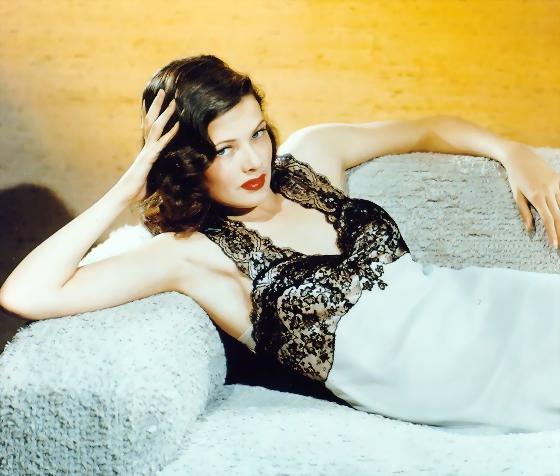
In Laura, the other characters talk about her mostly in flashback for an excruciatingly long period of time because she’s presumed dead — and they speak about her with such reverence that the gritty, laconic police detective Mark McPherson (Dana Andrews) starts to fall in love with her in a clumsy way, gazing at her portrait. Maybe it’s easy to idealize a dead woman; no one has any doubts about why McPherson falls so hard. As a kid watching it for the first time I had no idea that she would appear, like a vision, midway through the film, not dead at all, and slightly harder in real life than the idealized version would have had her. It’s a terrific plot twist — and the only problem I ever had with that brilliant film was that I was never sure why Laura fell for him, too.

So imagine my delight to discover Where the Sidewalk Ends, also starring Andrews and Tierney, also directed by the great Otto Preminger. I can’t emphasize enough what a great film this is, and such a great follow-up to Laura. Andrews’ character is even named Mark again, which gives Tierney the chance to pronounce it Mahwk in that same low, refined way. Andrews is a complicated, crooked anti-hero, much more fleshed out and darker than in the earlier film; his mouth is set in an even more unforgiving, hard line, especially in all those bitter close-ups. It’s as if he’s still that other Mark, except more brutal. And Tierney almost seems to be Laura again except a sad six years and an unhappy marriage later. She’s just as beautiful, but a bit haunted and still attracted to the wrong men.

The earlier film Laura haunts Where the Sidewalk Ends just the way the portrait/fantasy of Laura haunted Mark McPherson. But in the latter, their tentative romance plays out against the gritty city streets of New York, filmed beautifully on location, and in an ordinary little café, owned by an older woman Mark helped out of a jam that one time. The two of them banter/bicker back & forth at one another in a practiced way, which delights Tierney — who wouldn’t be charmed by a man whose biggest fan likes to joust with him while serving him bowls of soup?
See this film — it’s streaming on Netflix. Better yet, give yourself a two-night double feature of both films, in order. This is film noir at its best, and tell me whether it makes you fall for Tierney’s mystery as well.
Leave this kind of writing to the professionals.
5 October 2011

Novelist James Agee was famous during the 1940s for his movie reviews in The Nation and Time — indeed, W. H. Auden called those reviews “the most remarkable regular event in American journalism today.” I’m reading some of them now, and they’re so terrific that they prompt me to emit involuntary outbursts of glee. His writing somehow packs all manner of ideas into single sentences without taking on that confusing and bloated quality that one sees in one’s own writing. For example, about the film Out of the Past (above) Agee writes:
In love scenes [Robert Mitchum’s] curious langour, which suggests Bing Crosby supersaturated on barbiturates, becomes a brand of sexual complacency that is not endearing. Jane Greer, on the hand, can best be described, in an ancient idiom, as a hot number.
I can’t even tell you how happy this kind of writing makes me. And how much it makes me need to see Out of the Past again. And how much it makes me warn amateurs against attempting such feats of descriptive gymnastics. (Many thanks to the Unexplained Cinema site, which turned me on to Agee’s collected film writing.)
Noir women: “Laura” (1944)
22 February 2011
I’m writing this for the Film Noir Blogathon, put together for the benefit of preserving important film noir by the Self-Styled Siren and Ferdy on Film. I realize I’m late to this party — it took me a while to find an appropriate film because noir women often aren’t very interesting (and women are, after all, my thing on this blog). Lucky, then, that Otto Preminger’s Laura came to mind. Gene Tierney was at the perfect height of her perfect beauty; we believe she’s been murdered for half the film, yet somehow she becomes nearly our protagonist by the end; she wavers between possibly murderous suspect and perfect wish-fulfillment fantasy girl. Most of all, she’s a strikingly sympathetic character for female viewers because of she’s a version of a self-made woman, yet she’s got only bad choices when it comes to men. In fact, I think one of the most fascinating subjects of this great film is class — hers, theirs, and what class does in relationships between men and women. At first, Laura Hunt (Tierney) is only the murdered girl, the one remembered by the other suspects because during her life she was fought over by two men: the middle-aged, imperious, deliciously venomous columnist Waldo Lydecker (Clifton Webb) and Shelby Carpenter (Vincent Price), a slippery, smooth-tongued Southern gentleman down on his luck. Fought over for good reason. Laura was smart and beautiful, came up through the ranks at her advertising agency, was beloved for her gentleness and elegance. They speak of her in reverent terms. No wonder the detective assigned to the case, Mark McPherson (Dana Andrews), falls a little bit in love with her himself, and falls asleep in her apartment underneath her lovely portrait — raising the question why a 22-year-old career woman in 1940s New York would have her own portrait above the fireplace. It’s such a lovely picture, however, that we don’t wonder for long.
 That’s the thing, you see: Laura’s class is unclear, as she’s not exactly a self-made woman. Sure, she started out as a low-level copywriter in her firm, but it was Waldo’s mentorship, influence, and assistance in gaining attention and prestigious endorsements that led to her professional rise. He also helped decorate her apartment — even going so far as to loan her beautiful objects d’art for display, thereby imprinting her flat with his rococo/queer sense of feminine taste. In return, she showered him with appreciation, admiration, and a feminine gift for listening to him read his own columns aloud. As far as Waldo is concerned, her only shortcoming was her tendency to fall in love with men who didn’t deserve her; he wanted her to remain the ever-dedicated, supplicant woman who made him look good. As Waldo explains in a long conversation with Mark:
Laura had innate breeding, but she deferred to my judgment and taste. I selected a more attractive hairdress for her. I taught her what clothes were more becoming to her. Through me, she met everyone. The famous and the infamous. Her youth and beauty, her poise and charm of manner captivated them all. She had warmth, vitality. She had authentic magnetism. Wherever we went, she stood out: men admired her, women envied her. She became as well known as Waldo Lydecker’s walking stick and his white carnation. But Tuesday and Friday nights we stayed home, dining quietly, listening to my records. I read my articles to her. The way she listened was more eloquent than speech. These were the best nights. Then one Tuesday, she phoned and said she couldn’t come.
Shelby’s motives are even less attractive: having come into Laura’s life after her professional and social successes, he wants to ride her coattails — she’s already given him a job at the firm — and, probably, milk her for cash. In short, for Shelby Laura is a guarantor of status and income, while for Waldo she’s the perpetually grateful recipient of a hand up. Nor are we viewers confident things would be different with Mark. Waldo’s right: Mark calls women “dames” and “dolls,” laments the time a “doll in Washington Heights got a fox fur out of me,” and seems partly impressed with Laura because she’s just so exotic to his gritty life. Sitting in her crazily feminine apartment he seems almost creepy, even as we forgive him his awkwardness. Who is this Laura, really, with all these different views of her?
Complicating this smoky view of the film’s central figure is its propensity to shift protagonists. At first it would appear Waldo is our man, with his snarky narration and terrific gift with one-liners (the screenplay is perfect, most of all when a good line is handed to the brilliant Clifton Webb). Mark McPherson is a laconic, unassuming character with the questionable habit of toying with a little pocket puzzle rather than look anyone in the eye. But suddenly 30 minutes in, a long shot of Mark signals that things have shifted; we start following his investigation and privileging his view of the case, especially as he thumbs through Laura’s diary and letters or interviews her devoted maid, Bessie. Yet even as we watch Mark become obsessed with the dead girl, he’s more of a mystery than a full-fledged protagonist — so when Laura reappears in her apartment demanding to know what he’s doing there, we might be ready to shift our loyalties to her. Except for the fact that if she’s not the victim, she might be the murderer.

According to old-movie and film-noir logic, it’s natural that Laura would fall in love with Mark — our damaged protagonists should always get the girl in the end. But female viewers might view this narrative progression sideways. She clearly makes more money than this down-in-the-mouth detective and lives a more glamorous life with that money. When we see her deal gracefully, effortlessly with the maid Bessie as if she’d had hired maids all her life, we get an indication not just of that “innate grace” Waldo described; but we also see that Mark shares more in common with Bessie than with Laura. With his clenched-jaw lack of conversation, he won’t just fit in to her life, which means that perhaps she’ll be the one to sacrifice it to be his wife. Or will this be yet another of her brief, unsatisfying relationships with inappropriate men? That’s the most likely scenario; we won’t arrive at the answer, of course, because the film ends too soon. But we can speculate and think about how Laura‘s shifting protagonists begs female viewers to perceive a different narrative emerging from the film. Maybe I’m reading the film anachronistically — maybe we’re supposed to see Laura as a woman who makes do with the inadequate men presented to her. But somehow I don’t think so. I think one of the reasons this film still works so well is that nagging feeling one still has at the end, even after the murder mystery has been cleared up, that there’s still more misery in store for our heroine.


 Feminéma